A weekly reckoning with our
overheating planet—and the fight to save it
|
|
|
|
|
|
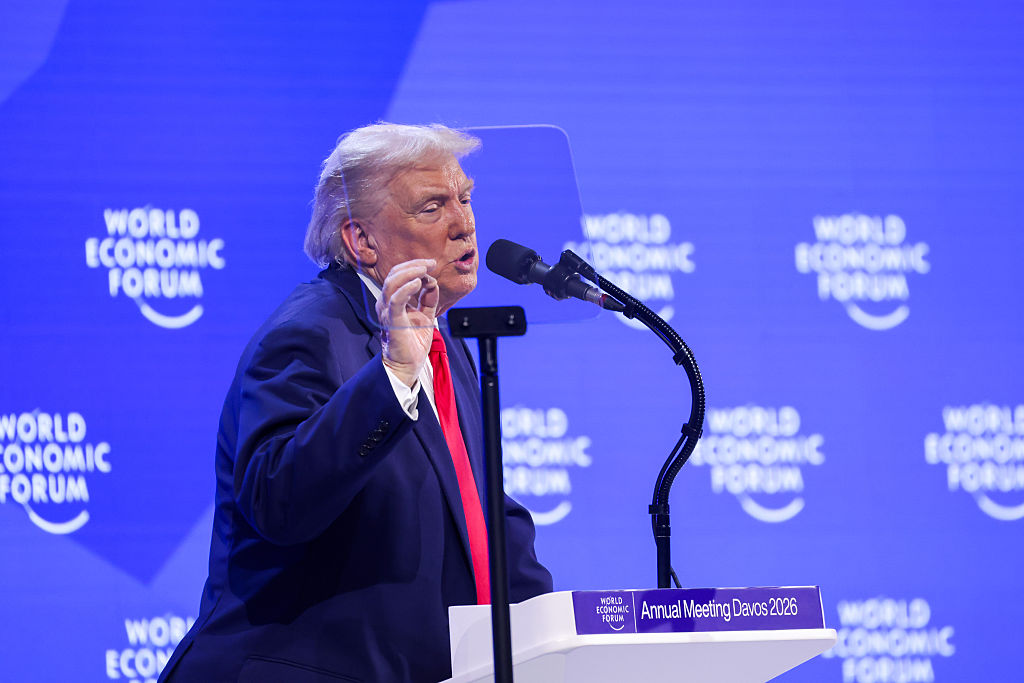
President Donald Trump at the World Economic Forum on January 21 Bloomberg/Getty Images
|
On Wednesday, President Trump traveled to Davos, Switzerland, for the World Economic Forum and delivered a speech that was unusually unhinged, even by his standards.
He claimed to have solved the energy requirements of the AI boom. He said, "There are windmills all over Europe, there are windmills all over the place, and they are losers." He claimed would-be drillers had come to him asking for his help against the radical left so they could extract oil in the North Sea. He said China sells wind turbines to fools, but "I haven’t been able to find any wind farms in China.… They sell them to the stupid people, but they don’t use them themselves."
He claimed the United States deserved to get Greenland now after defending it in World War II. He said the U.S. has even better battleships now than it did then. He mixed up Greenland and Iceland, saying Iceland "loved me. They called me Daddy." He said the U.S. needed ownership of Greenland because "you can’t defend it on a lease.… Psychologically, who the hell wants to defend a license agreement or a lease which is a large piece of ice in the middle of the ocean, where, if there is a war, much of the action will take place on that ice? Think of it, the missiles will be flying right over the center of that piece of ice."
|
|
|
To complement The New Republic’s March 2026 issue, "What Should the Democrats Do?" our writers examine how the Democrats can reestablish themselves as the party of and for the people, hone their messaging, and push the electorate to be more progressive.
|
|
|
He talked about young soldiers’ heads being "blown off" in the war in Ukraine. He threatened to prosecute people over the results of the 2020 election. He boasted about his chauffeur being able to do a better job than NATO generals, "and he makes slightly less than 50[k]." He mentioned Emmanuel Macron’s sunglasses, and affected a French accent while relating a conversation he and Macron had about prescription drug pricing. He said he was working "to ensure the U.S. remains the crypto capital of the world." He said Minnesota Representative Ilhan Omar "comes from a country that’s not a country." He said he could destroy the U.S. housing market if he wanted to.
It wasn’t so long ago that traditional media outlets felt obligated to pretend that the World Economic Forum meeting in Davos had something to do with saving the world. Even after financial executives crashed the economy into the Great Recession, the technocratic optimism of the Obama years drove the myth forward. (U.S. Treasury Secretary Tim Geithner was treated like something between a genius and a Hollywood philanthropist.) We were meant to believe that the CEOs weren’t there to lobby politicians, the politicians weren’t there to shop for lucrative post-political gigs, and the academics weren’t there for the caviar or to see Charlize Theron. Instead, all of them were there to solve malaria—or global poverty, war, HIV, and the climate crisis.
The climate crisis was always the issue that most thoroughly exposed the absurdity of this conceit. With malaria, poverty, HIV, and world peace, leaders could at least pretend that getting everyone together in the same ski town for a big party was like buying a lot of athletic wear for a New Year’s resolution to go to the gym.
With climate change, however, it was more like buying a lot of athletic wear and then taking a cab across town in the opposite direction from the gym. Oil companies were formal partners for the event, which was marketed as being carbon-neutral while it involved a bunch of corporate and governmental executives flying via private jet to an Alpine town whose signature sport climate change is currently decimating. The confab hyped "solutions" like carbon credits and carbon capture that would allow corporations to keep polluting as usual—even as rigorous reporting showed a lot of carbon credits weren’t backed by real reductions and carbon capture wasn’t yet feasible at scale. Panelists who pointed out the problems with this approach, as TNR’s Kate Aronoff noted in 2023, were patronized and dismissed. The companies that were bragging about their net-zero goals in those years have now abandoned them altogether.
Now Trump has dropped this wild, threat-filled tirade into the mix. He’s demanding ownership of Greenland, threatening catastrophic trade wars, hinting at military takeover, all while asking world leaders to pay $1 billion to join some sort of security racket that’s presumably intended to replace NATO, which he seems determined to destroy. There’s a rich tradition in media of treating Davos as an entertainment story, but that may be hard when there’s a credible risk of armed conflict or economic destruction.
Yet as off-the-wall as Trump’s speech was, it’s hard to argue that he fundamentally misunderstood the assignment. Yes, this is different in kind from what has gone before. But Davos has always been a racket—albeit one that’s usually a little more veiled by civil discussion and closed doors. Maybe this is the year that finally exposes the Davos myth. Trump’s tirade was terrifying, but we all should have been scared much, much earlier.
|
—Heather Souvaine Horn, deputy editor
|
|
|
Join a special group of readers and supporters on a lovingly designed, all-inclusive tour of one of the most spellbinding places in the world. Drawing on The New Republic’s special contacts among local historians, artists, and chefs, we’ve created a first-class experience that will immerse you in Cuba’s colorful and unique history, politics, and culture.
|
|
|
That’s how much extra land would be needed, according to a recent estimate reported by The Guardian, if Americans were to modify their diets even part of the way toward RFK Jr.’s new food pyramid—increasing meat consumption by 25 percent.
|
Last fall, the real estate platform Zillow quietly stopped publishing climate risk ratings on its listings. Having one’s home wiped out tends to ruin people when it doesn’t kill them, but talking about that is apparently too much of a bummer for the real estate industry. Now, Inside Climate News reports, there may be a way to DIY it:
|
Neil Matouka, who previously managed the development and launch of California’s Fifth Climate Change Assessment, is developing a proof of concept plugin that provides climate data to Californians in place of what Zillow has removed. When a user views a California Zillow listing, the plugin automatically displays data on wildfire and flood risk, sea level rise and extreme heat exposure.
"We don’t need perfect data," Matouka said. "We need publicly available, consistent information that helps people understand risk." … Both independent academic research and research conducted by Zillow has found that disclosing flood risk can decrease the sale price of a home. "Climate risk data didn’t suddenly become inconvenient. It became harder to ignore in a stressed market," First Street said.
|
|
|
Last year, Trump had a lot of people scared. But there are good—and encouraging—reasons to think that this year will be different.
|
|
|
|
|
Update your personal preferences for _t.e.s.t_@example.com by clicking here.
Our mailing address is:
The New Republic, 1 Union Sq W Fl 6 , NY , New York, NY 10003-3303, United States
Do you want to stop receiving all emails from ?
Unsubscribe from this list. If you stopped getting TNR emails, update your profile to resume receiving them.
|
|
|
|
|