GOOD MORNING, HERE’S WHAT’S HAPPENING: The Wall Street Journal reported very early this morning that Elon Musk personally "ordered the slowdown of a military-grade version of Starlink" for Ukraine. Umm … isn’t that the sort of thing a president should do? The Journal reports that Musk "talked to multiple senior administration officials, including with Trump, before imposing the new speed cap, which Ukrainian officials said had allowed Russian missiles to evade their defenses."
THAT RAMASWAMY AD: Ferocious blowback continues to the Vivek Ramaswamy ad in which Amy Acton’s estranged mother—who abandoned her when she was a youngster to stay with the man who raped the 12-year-old Acton—calls Acton a serial liar. Ramaswamy defended the ad and will spend $4 million on it. Many Democrats and a few Republicans have criticized the ad so far. John Heilemann said on Morning Joe: "In my 35 years of doing this, I don’t think I’ve ever seen an ad that crossed as many ethical, moral, and just sort of lines of decency as this one has." Added Mika Brzezinski: "There is something worse about this than we have ever seen ever in a political ad." Question: GOP Senate candidate Jon Husted will surely be asked about this ad; what will he say? As of last night, The Hill was reporting that Sherrod Brown had called on Husted to denounce the ad; no word from Husted-land so far.
TRUMP PLAYING MORE DEFENSE: After yesterday’s rally in a state (North Carolina) that the Republican Party has already left for dead, President Donald Trump today heads to South Carolina to stump with Darline Graham. Interestingly, Cook just moved the South Carolina Senate race from "likely Republican" to "lean Republican." In MS NOW’s polling averages, Graham leads Annie Andrews by 1.7 percentage points.
"IF YOU WRONG US, SHALL WE NOT REVENGE?": The ADL and CEO Jonathan Greenblatt are taking some heat for their statement concerning Trump once again using the antisemitic slur "Shylock"—this time while campaigning in Kansas for Roger Marshall on Monday. The statement failed to mention Trump by name and used the locution, "Regardless of intent…" Democratic foreign-policy guru Matt Duss wrote on X: "If a Democrat said it Jonathan Greenblatt would be knocking people over to get in front of a camera to condemn them by name, but it was Trump so it’s just a general public service announcement."
|
Beating Jeff Van Drew is personal. Can Democrats finally do it? |
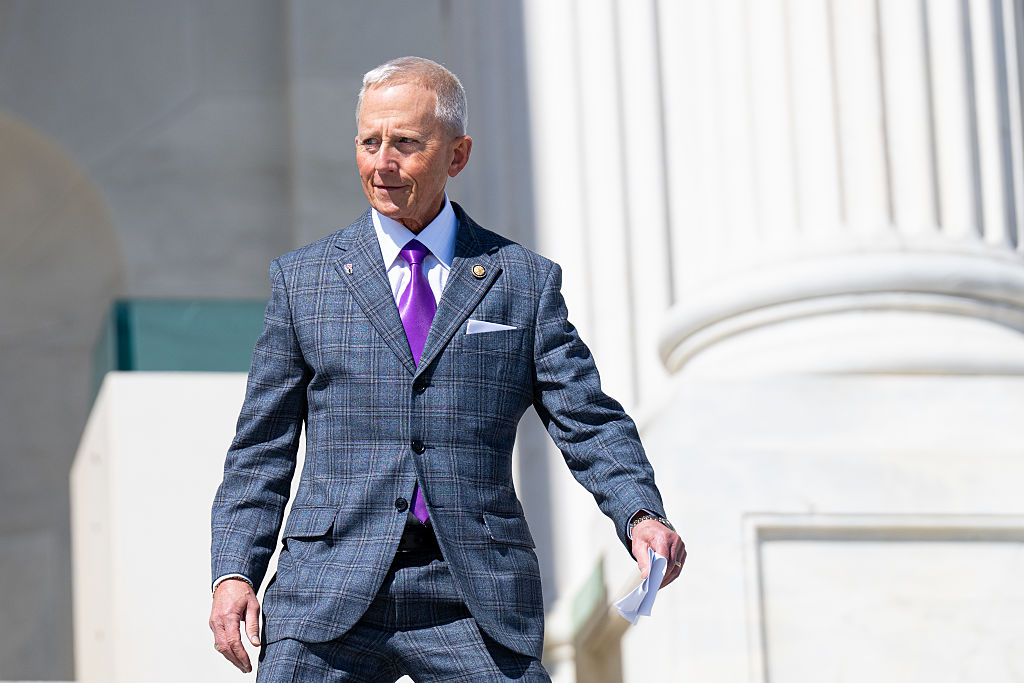
New Jersey Representative Jeff Van Drew Bill Clark/Getty
|
Democrats seriously dislike Jeff Van Drew: The Republican representative of New Jersey’s 2nd congressional district used to be a Democrat until 2019, when he switched his party affiliation after voting against the impeachment of President Donald Trump. Now, Democratic Cape May Mayor Zack Mullock thinks he could finally unseat Van Drew. Earlier this year, that seemed impossible. But amid near-nonexistent public polling in the district, Mullock claims that internal numbers give him a chance. In a sign of the times, Sabato’s Crystal Ball on Tuesday shifted the race in Democrats’ favor, from "safe R" to "likely R."
Van Drew has been untouchable for years. In 2024, he won reelection by 17 points. But experts say that three national trends this year might undermine his support: affordability struggles, disillusioned Hispanic voters, and data center blowback. "Our internal polling shows that we’re within one, which is huge," Mullock told supporters in Vineland on October 17. The most recent public poll was conducted in May 2025 and showed Van Drew up by 10 points against a generic Democrat.
Van Drew’s campaign dismissed Mullock’s claim. "Every cycle the Democrats get together, commission a fake poll saying this seat is in play to use as a fundraising ploy, and every year Congressman Van Drew proves them wrong—this is nothing new," Ron Filan, Van Drew’s campaign manager and director of political affairs, wrote in a statement. But in early October, the Democratic Congressional Campaign Committee (DCCC) added the race to its list of districts in play, a sign that internal polling might actually be stronger than Van Drew’s team suggests. "Either one point or 10 points is a shift from two years ago, when Van Drew carried the district by 17 points," said Micah Rasmussen, the director of the Rebovich Institute for New Jersey Politics, who managed a handful of Van Drew’s state legislator campaigns between 1994 and 2001.
Mullock’s appeal hinges on his moderate messaging and past successes in the conservative Cape May area. On his website, he describes himself as "an independent voice for working families," and it’s hard to find a mention of party affiliation. That’s important in the 2nd congressional district, explained Matthew Hale, a professor of political science at Seton Hall University. In New Jersey, he said, there isn’t "an enormous number of far-left or far-right folks compared to the rest of the country." But they do have some far-right voters, he said, "and most of them live in the 2nd district."
Hale thinks those voters will likely sink Mullock. "There’s a wall there for the Republican incumbent," agreed Benjamin Dworkin, the founding director of the Rowan Institute for Public Policy & Citizenship at Rowan University. "Whether the Democratic wave is big enough to go over it is unclear." But Mullock may be able to gain some appeal among the district’s Hispanic voters, who are concentrated in Atlantic City, Vineland, and Millville. Nationally, Hispanic voters have trended away from Trump and Republicans. They were a critical part of Trump’s 2024 coalition, but now about six in 10 disapprove of his handling of the presidency.
Mullock could also benefit from Van Drew’s past support for a data center project in Vineland, which has been the focal point of grassroots organizing. Vineland residents are deeply concerned about the data center’s noise pollution, local water quality, and their electric bills, The New Republic’s own Kate Aronoff wrote in September. Like many politicians, Van Drew was originally supportive of data center development, but he changed his tune once the political winds shifted. One developer involved with the project called Van Drew’s support for it "critical"—a detail that Mullock has highlighted in social media posts. Neither candidate immediately responded to The New Republic’s inquiries about data centers.
As in other parts of the country, New Jersey residents are tying data centers to their affordability concerns, which are particularly acute in a "hardscrabble" area like the 2nd district, Rasmussen said. Plus, there are environmental concerns: Rasmussen’s own mother lives four miles from the data center and can hear it humming at night. The center runs on diesel generators that release pollution into the air without state permission.
Van Drew might well prevail despite all this. But Democrats are hungry to hand him a loss. "He has certainly earned the everlasting animosity of Democrats in the district," Rasmussen said. "There’s a tremendous sense of betrayal."
|
Matt Ford lays out Trump’s latest abusive power grab and assault on the Constitution … Timothy Noah on The Washington Post’s union-bashing obsession … Perry Bacon explains why even a major blue wave won’t solve the oligarch problem.
|
Julian Curo-Churata’s family is still waiting for answers about how the 47-year-old died of "cardiac arrest" due to "septic shock" while at an ICE detention center on September 29, two days after reportedly being in perfect health on a phone call with his wife. Maryland Democratic Senator Chris Van Hollen has demanded a "full independent investigation" into the death, which is one of "at least 59" that occurred in ICE custody under the second Trump administration, according to The Washington Post’s tally. The Post’s Liam Bowman reports the troubling details of the case: from ICE arresting the father of three in Laurel, Maryland, on his way to work; to Curo-Churata’s three-month detention in Louisiana; to his daily attempts to reassure his six-year-old daughter via video call that he was just working on a construction job and would be back soon; to him actually volunteering to self-deport to Peru so he could "reunite" with his family (a judge denied this request); to a drive between the detention center and the hospital that should have taken seven minutes and inexplicably seems to have taken almost two and a half hours. Bowman reports that, as of Monday, the local coroner still had not completed an autopsy report.
The Texas Tribune reports that 288 new data centers currently planned for the state could raise nitrogen oxide emissions (famously bad for the respiratory system, in addition to causing acid rain and combining with other molecules to increase fine particulate pollution) by 35 percent by 2031, erasing "decades of progress." But if the centers rely largely on natural gas, nitrogen oxide levels could rise by 146 percent, alongside large spikes in volatile organic compounds and particulate matter. Data centers have become an unexpectedly large issue in the governor’s race. Texas now has 419 of them, making it second only to Virginia (490). Democrat Gina Hinojosa has called for a moratorium on the centers until the government can pass protective legislation. In recent months, Governor Greg Abbott has declared his support for regulations to curb the industry. But a recent report from FracTracker and Public Citizen found that, despite his very public ordering of a "pause" on permits in late August, state regulators are still processing permits. (The Abbott administration responded to the report by insisting that no permits have been "approved.") On Monday, the Tribune calculated that Abbott has received some $9 million from "data center-related donors" since July 2025.
|
At the Center for American Progress, Angelo Villagomez and Beth Pike review the Trump administration’s proposed policy changes on fishing in protected marine national monuments and explain the potential impact. Their takeaway: "Nationally, the five rollbacks threaten to eliminate 87 percent of the nation’s highly protected ocean waters; at the same time, they account for a staggering 21 percent loss in high-level marine protection globally. The United States would be left with only 3 percent of its marine waters protected and likely to support biodiversity benefits."
Groundwork Collaborative and The Century Foundation estimate that the price of "Halloween candy favorites have jumped 15.3% over the past year, more than four times the rate of overall inflation." You might assume that’s just due to the global increase in chocolate prices, but no: The company behind Sour Patch Kids and Swedish Fish raised prices by an eerie 39 percent.
|
Penguin Press, 384 pp., $30
|
|
THE GIST: The Baffler founder and "scoffer by trade" is back, and this time it’s with a book aimed at innovation—which is to say at America’s very self-conception.
PRAISE: Publishers Weekly says that "Frank’s wry critique exposes how creativity and innovation are ‘a marker of ghastliness,’ wielded as a justification for policy that benefits only the so-called enlightened few. It’s a sharp look at how prized American values mask inequality."
CRUISING THE INDEX: Like many of Frank’s books (including What’s the Matter with Kansas? and Pity the Billionaire), The Creativity Con is sweeping—part history, part sociology, part exposé. It’s not shocking that the tech industry comes under special scrutiny, but Frank’s target is larger than Silicon Valley: It encompasses Lockheed Martin, Madison Avenue, Donald Trump, and Richard Florida.
TNR’S QUICK CRITICAL ASSESSMENT: "Creativity and innovation are essential to the story of how our modern economic order was cemented into place," Frank writes. That’s what this book is really about: not just the con at the heart of innovation, but how elites use innovation as a tool to ensure an economic order that benefits them—and leaves everyone else behind.
|
|
|
POLITICAL TRIVIA QUESTION OF THE DAY
|
|
|
|
According to howstuffworks.com, the most offensive political ad of all time (arguably until today, that is) was a 2011 right-wing attack ad on Democratic Los Angeles-area congressional candidate Janice Hahn in a special election. What kind of activity did the ad try to tie her to? |
Yesterday’s question and answer:
Q: For a few days in October 2008, Ashley Todd seemed like she might loom large in that year’s election. But her story turned out to be false. What did she allege happened to her, and what was the bizarre tell that she was lying?
A: The young Texas woman was a volunteer on John McCain’s presidential campaign. She was in the Pittsburgh area recruiting when she claimed that, on October 22, she was mugged by a Black man who saw the McCain bumper sticker on her car and assaulted her, carving a "B" into her face (for "Barack"). The bizarre tell? The "B" was backward, indicating to police that she had carved it into her own face while looking in a mirror, as she later admitted.
|
|
|
GET IN TOUCH WITH US
Democratic Hill staffers and political operatives, progressive activists and think tankers and insiders—have a news tip for us, or a thought about something you think we should cover? Let us know by writing to thebluebook@tnr.com. Our staff is small, but we'll do our best!
|
|
|
|
|
|
Were you forwarded this email? This is The TNR Blue Book—the only newsletter that takes you inside what’s happening with the Democrats on Capitol Hill and beyond, and in the world of progressive debate and ideas. Sign up for free.
|
|
|
|
|
|
|