A weekly accounting of the rogues and scoundrels of America
|
|
|
|
|
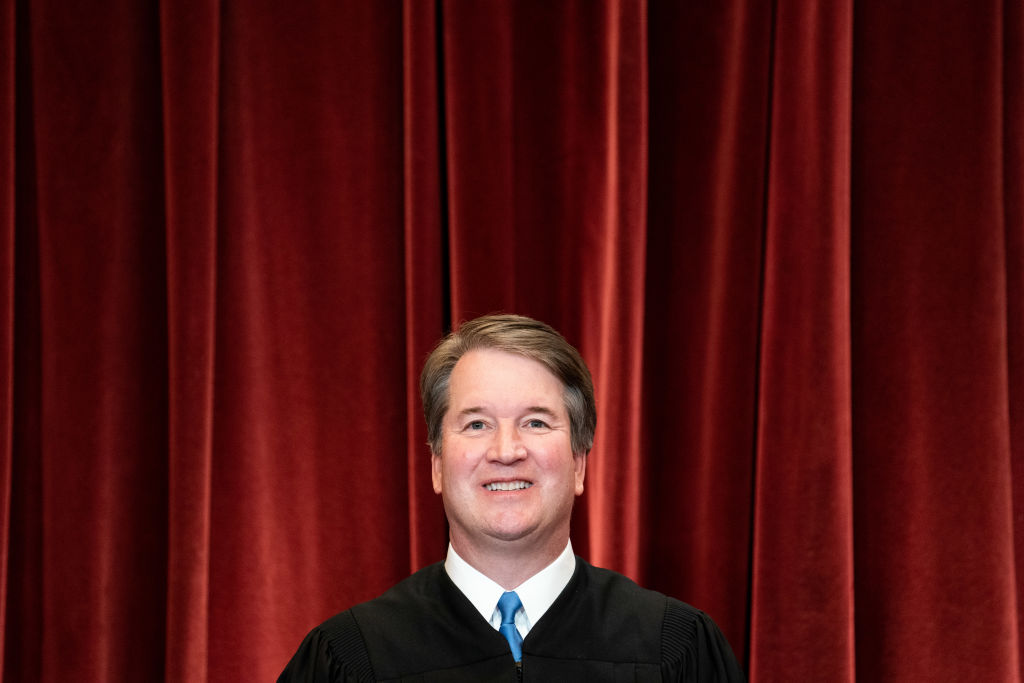
Associate Supreme Court Justice Brett Kavanaugh Pool/Getty
|
Believe it or not, there was a time when the Supreme Court’s emergency docket rulings did not regularly garner controversy; they were simply the means by which the court could consider time-sensitive legal crises, such as motions related to capital punishment. But a key feature of the Trump era is the transformation of the emergency docket into the "shadow docket": unsigned rulings that have had a profound effect on the country. Beyond the fact that these rulings have a "heads Trump wins, tails Democrats lose" bent, they are, as Erwin Chemerinsky notes, often proffered without much in the way of jurisprudential explanation while frequently bulldozing precedent. The justices themselves may not like the term "shadow docket," but they seem to relish operating in the shadows all the same.
But there is one instance in which a justice did attempt to explain himself in a recent shadow docket ruling, only for that justice’s reasoning to blow up nearly immediately after its first encounter with the real world: Brett Kavanaugh’s concurring opinion in Noem v. Vasquez Perdomo, in which the Supremes stayed a lower court ruling that was specifically impeding the Department of Homeland Security from racially profiling people for immigration stops. The larger court, as is its wont, failed to offer a ruling. But Kavanaugh opted to weigh in all the same. His reward is a heaping helping of infamy in the form of a specific secret police tactic that many have taken to calling "the Kavanaugh stop."
Here’s the essential background. As TNR’s Matt Ford reported after the ruling in Noem was handed down, Kavanaugh’s surprise concurrence went to some pains to "minimize the impact" of a law enforcement encounter: "Importantly, reasonable suspicion means only that immigration officers may briefly stop the individual and inquire about immigration status," Kavanaugh wrote. "If the person is a U.S. citizen or otherwise lawfully in the United States, that individual will be free to go after the brief encounter. Only if the person is illegally in the United States may the stop lead to further immigration proceedings."
|
|
|
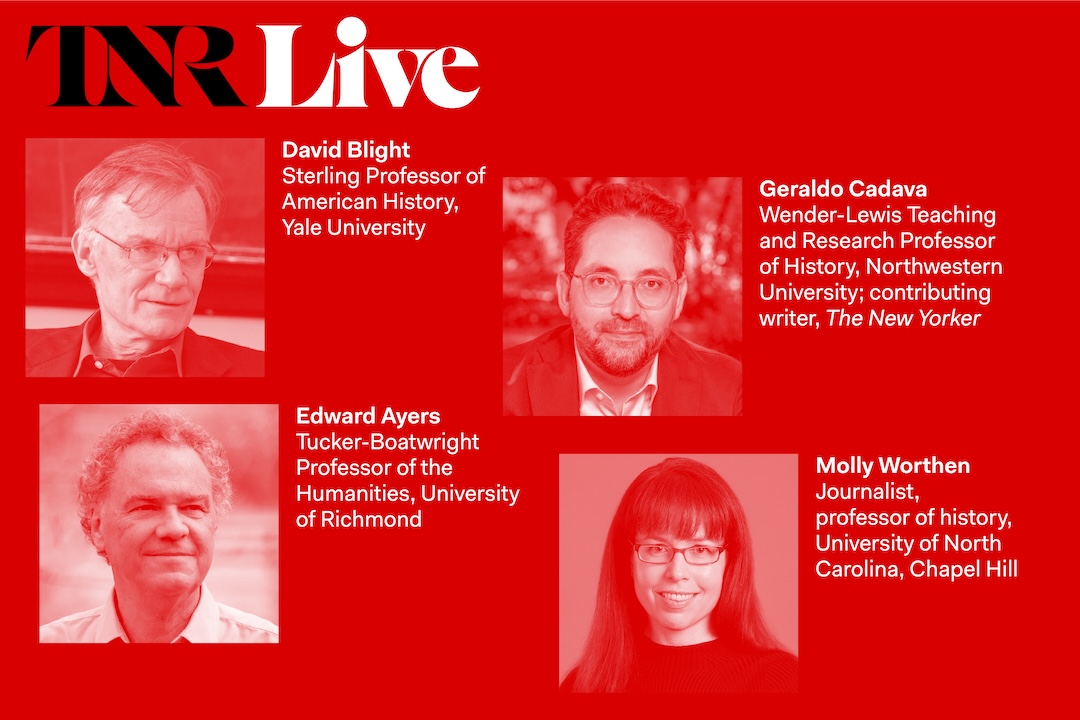
Following up on our last conversation around our September issue, join The New Republic and David Blight, Yale University’s Sterling Professor of History, for a discussion with fellow academics on how they must fight to preserve our history and democracy.
|
|
|
As Ford noted, the law enforcement encounters that formed the basis of the case itself could hardly be called "brief." One of the plaintiffs in Noem testified that his attempt to show valid proof of U.S. citizenship did not make the encounter any shorter, as the agents "refused to believe the validity of his California driver’s license." As Justice Sonia Sotomayor recalled in her dissent, "The agent said the ID was insufficient, ‘grabbed [his] arm,’ escorted him to a vehicle, and drove him to a ‘warehouse area’ for further questioning." None of that sounds at all like the quick interaction that Kavanaugh suggested was the theoretical norm. And in practice, the Kavanaugh stop hasn’t hewed to his imagined brief encounter, either.
The quintessential components of a Kavanaugh stop involve a person detained for immigration enforcement specifically, with race a certain or likely factor in the decision behind the stop—the Fourth Amendment’s protections from unlawful searches and seizures be damned. Sotomayor saw a grim future in the court’s decision: "We should not have to live in a country where the Government can seize anyone who looks Latino, speaks Spanish, and appears to work a low wage job."
If the news is any guide, Sotomayor’s fears are now reality. As the Chicago Tribune recently reported, Chicago resident Rueben Antonio Cruz, a 60-year-old man originally from El Salvador, was sitting with a friend in Rogers Park when "immigration officers stopped their truck and went straight after them." What followed was a classic Kavanaugh stop: Cruz and his friend were asked for "papers" proving their citizenship. Cruz, who was not carrying such papers on his person, was then bundled into the agents’ vehicle and interrogated. Cruz was eventually let go, but not before the agents fined him $130 for "not having his papers." The ordeal left Cruz angry: "It’s not fair because I said, let’s go to my house and I’ll show you my papers. I’m a resident."
The Tribune notes that while federal law requires registered foreign nationals to carry proof of registration with them at all times, "prior to a second Trump administration, it was rarely enforced." The detention drew the criticism of the ACLU’s Ed Yohnka: "America has never been a place where people need to ‘show one’s papers.’ Ticketing a lawful permanent resident—and forcing him to appear in court and pay a fine for not carrying their papers—is unnecessary and cruel." Unfortunately, it’s likely to become commonplace as Trump’s goons, freed from legal obligations by the Supreme Court, make the Kavanaugh stop part of their daily operations.
The possibility that Trump’s ICE agents, who have effectively been given carte blanche to abuse their authority, might simply dismiss their quarry’s valid proof of citizenship appears to have not occurred to Kavanaugh. But it has definitely occurred to the jabronis snatching up brown people in American cities. In a second Kavanaugh stop detailed by the Tribune, a 44-year-old Latina woman named Maria Greeley was out for a jog when she was jumped by federal agents who zip-tied her and detained her despite the fact that she carries her passport with her at all times to prove that she was born in the United States. According to the report, agents remarked that she didn’t "look like a Greeley," dismissed her documentation, and accused her repeatedly of lying.
One of the most obviously impeachable things about the Supreme Court is that it’s so frequently out of touch with the real world—a perhaps inevitable condition of giving nine people special robes and lifetime job security and then stuffing them inside a sepulchral building to stew in their own partisan juices with no one to answer to. Kavanaugh’s flawed reasoning may simply be the product of profound naïveté. But since this all came about in a shadow docket case in which the Trump administration asked for emergency relief in the form of the permission to racially profile people, I think it’s hardly beyond belief to think that Kavanaugh felt compelled to try to put a good spin on a reprehensible ruling.
That Kavanaugh has to own the Kavanaugh stop is cold comfort. Who knows if it’s even possible to shame or humiliate Brett Kavanaugh anyway? It’s very possible that transforming the United States into a country more reminiscent of Nazi Germany’s "Ihre Papiere bitte" era is precisely the legacy that Kavanaugh sought for himself. We’re the ones who are stuck with the consequences.
|
—Jason Linkins, deputy editor
|
|
|
TNR Travel: December 13–20 |
For more than a century, The New Republic has brought Cuba’s vibrant story to life. Now we invite you to live it—and you can save $200 when you reserve your spot.
Join a special group of readers and supporters on a lovingly designed, all-inclusive tour of one of the most spellbinding places in the world, and immerse yourself in local history, art, and culture on a first-class experience that will be remembered for years to come.
Don’t miss this chance to experience Cuba’s rich culture—with savings to match. Get more information.
|
|
|
What Subscribers Are Reading |
There’s one simple pledge Democrats can make to voters about ICE that’s easy to understand and will have broad support.
|
|
|
When your money runs the world, it also runs you.
|
|
|
|
|
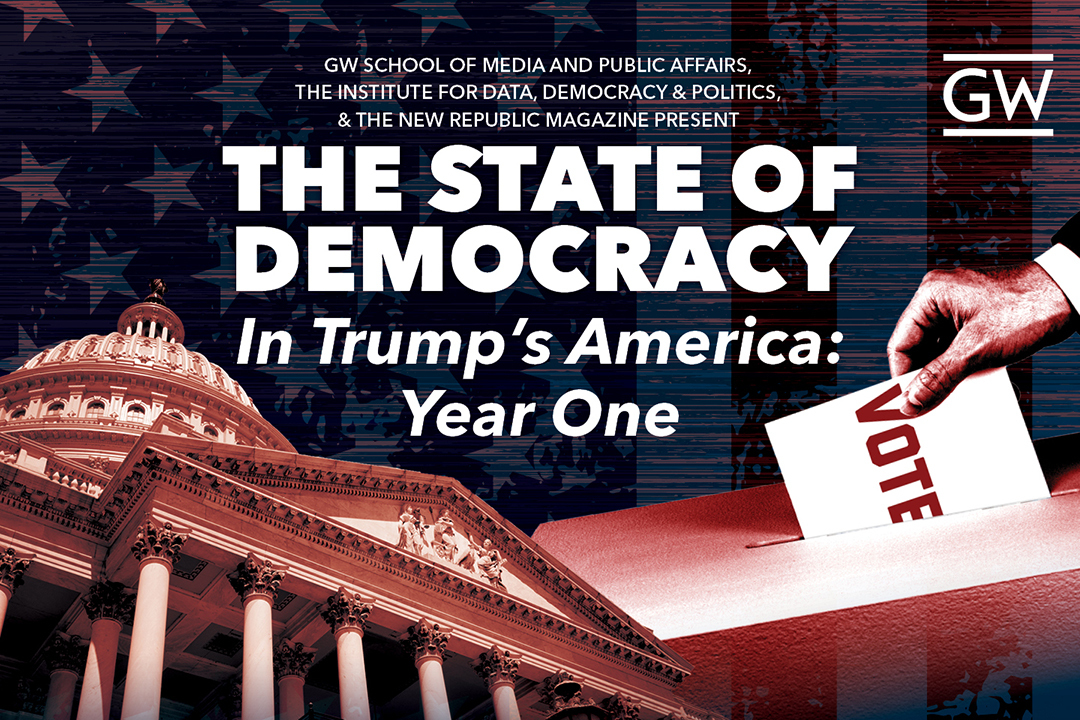
Join us on Tuesday, October 21, for a keynote address from Congressman Ro Khanna and a discussion between Harvard University’s Ryan Enos, the University of Chicago’s Susan Stokes, and Pulitzer Prize–winning journalist Eugene Robinson, moderated by Michael Tomasky, editor of The New Republic. The event will be a frank discussion of the challenges that the Trump presidency poses to democratic institutions and norms in the United States.
|
|
|
Update your personal preferences for _t.e.s.t_@example.com by clicking here.
Our mailing address is:
The New Republic, 1 Union Sq W Fl 6 , NY , New York, NY 10003-3303, United States
Do you want to stop receiving all emails from ?
Unsubscribe from this list. If you stopped getting TNR emails, update your profile to resume receiving them.
|
|
|
|
|