A weekly reckoning with our
overheating planet—and the fight to save it
|
|
|
|
|
|
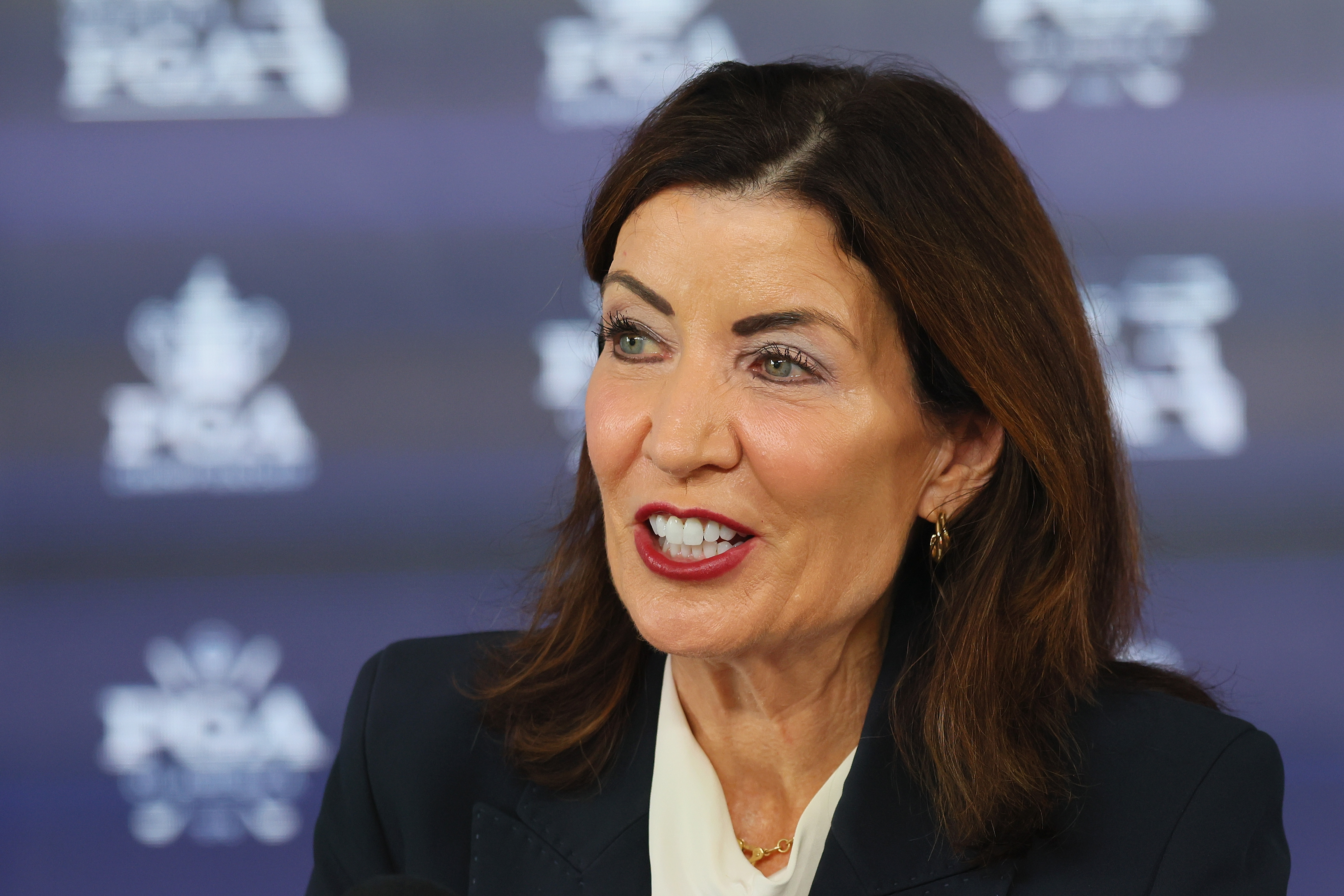
New York Governor Kathy Hochul Bruce Bennett/Getty Images
|
A note to my readers: This will be the last Life in a Warming World newsletter. TNR’s climate coverage will continue at NewRepublic.com. I’m switching to a new project that you’ll hear about soon.
|
Democratic governors’ affordability politics is trashing "what remains of U.S. climate policy," Politico reports this week. The piece points to New York Governor Kathy Hochul trying to delay legally binding emissions targets; Maryland Governor Wes Moore "backing legislation that would slash energy efficiency charges from utility bills"; Pennsylvania Governor Josh Shapiro pulling out of the Regional Greenhouse Gas Initiative (a cap-and-trade program); New Jersey Governor Mikie Sherrill using funds intended for clean energy to offset utility bill hikes; and Rhode Island Governor Daniel McKee "proposing to delay Rhode Island’s renewable energy standard, curb and rework solar incentives, and cap utilities’ ratepayer-funded energy efficiency spending"—all of which, Politico notes, "would torpedo the state’s aggressive climate timelines."
It’s even worse than that, as Will Peischel wrote for TNR last week. Blue governors are also openly embracing natural gas as part of an "all of the above" energy strategy (a phrase long since discredited as having led, under the Obama administration, to a disastrous boom in fracked gas and methane emissions). "We have gas pipeline expansion on the Algonquin—that’s good!" Massachusetts Governor Maura Healey recently said, although in 2022 she bragged about blocking two other pipelines in her work as attorney general. Hochul recently approved the Williams NESE pipeline "after the project twice failed to gain required approvals from state environmental regulators," Peischel noted. And Connecticut Governor Ned Lamont "supports building a compressor in the town of Brookfield, which would cram more gas through an existing pipeline."
|
|
|
It’s easy to portray these moves as inevitable and pragmatic—Democrats making the best of a tough situation and deciding to try to maximize gains in the 2026 elections. If Dems win big in 2026, climate policy will stand a better chance than it would have under Republican rule. But this logic crumbles under the slightest scrutiny. Even Politico—which has a history of pushing the false dichotomy between affordability and climate—isn’t falling for it. Hochul’s proposal, for example, "won’t lower bills," the article notes. Cutting renewable energy funds and energy efficiency programs will hurt money-bringing industries and trigger job losses. Meanwhile, Virginia Governor Abigail Spanberger is showcasing an alternative path: trying to rejoin the Regional Greenhouse Gas Initiative, portraying the move as ultimately a cost-saving measure that will raise money for energy efficiency programs.
There are lots of other ways that politicians could champion affordability politics without abandoning climate change. New York City Mayor Zohran Mamdani’s free bus proposal could incentivize the use of public transit instead of cars while helping people cut one of the infamous "big three" costs: housing, food, and transportation. Pretty much any program encouraging public transit could help both emissions and pocketbooks. That includes, as Liza Featherstone notes this week, congestion pricing, a policy frequently (and, as subsequent data has shown, misleadingly) demonized as hurting working people. While the right wing and some moderates often portray congestion pricing as imposing further burdens on commuters, "given the volatility of gas prices and car insurance, relieving people of the need to drive by using revenue to improve public transit is an urgent matter of economic justice," Featherstone argued.
These sorts of measures won’t work as well in rural areas, of course—but then, the East Coast states mentioned above are home to large urban populations.
Energy efficiency, in general, is one of the easier ways to help people save money. True, it can take some time to kick in: Paying for homeowners and landlords to install insulation and awnings, for example, isn’t an instant fix. But there are also ways to speed things up, such as via point-of-sale rebates. And cost savings from the new pipelines Healey and Hochul are advertising are somewhere between long-term and entirely fictional: New fossil fuel infrastructure takes a lot of time to build and is typically paid for by the consumer via utility bill hikes.
The list of options goes on and on: utility rate freezes (Hochul rejected this). Policies to promote green energy and energy efficiency without charging it to ratepayers. Policies to tackle rising food, housing, and health care costs.
There’s little excuse at this point for politicians accepting and perpetuating myths about a trade-off between climate policy and affordability. Data abounds that climate-friendly policies can save people money, and that climate change will put the cost-of-living crisis into overdrive.
|
—Heather Souvaine Horn, deputy editor
|
|
|
Get the most out of TNR’s breaking news and in-depth analysis with our membership subscriptions, featuring exclusive benefits that help you dive deeper into today’s top stories.
|
|
|
That’s how long a committee known as the "God Squad," convened by the interior secretary, took to discuss matters before agreeing to exempt drillers in the Gulf of Mexico from restrictions imposed by the Endangered Species Act, according to The Washington Post. The decision is anticipated to jeopardize the continued existence of the Rice’s whale, which is only found in these waters. Read more about the God Squad in Jonathan Rosenbloom’s piece for TNR here.
|
Mosquito-borne dengue fever is making a striking and disastrous comeback, Zoya Teirstein reports, and climate change could accelerate it. To people who might erroneously believe the U.S. is safe from this disease, Teirstein’s piece offers both a history lesson and a warning.
|
In the United States, mosquitoes are viewed as a nuisance, rather than the public health disaster they have long been in tropical nations like Brazil. That wasn’t always the case: The Centers for Disease Control and Prevention, or CDC, was established in 1946 to fight malaria around U.S. military bases. It was wildly successful in that mission, all but eradicating the disease from the country by the early 1950s with the help of the devastating chemical DDT. The agency learned a valuable lesson through that effort that still resounds today: Eradicating vector-borne disease is possible "in nations with temperate climates and seasonal malaria transmission."
But what happens when the climate becomes less temperate? Native and invasive tropical plants and animals move north, as average temperatures rise and winter freezes become weaker. Subtropical states—Florida, Alabama, Mississippi, Louisiana, Texas, New Mexico, Arizona, and California—begin to tropicalize, a process that will be all but complete by the end of the century, according to a 2021 report published by the United States Geological Survey, the Department of the Interior’s science agency.
"Tropical mosquitoes that can transmit encephalitis, West Nile virus, and other diseases," the report said, "are likely to further expand their ranges, putting millions of people and wildlife species at risk of these diseases."
|
|
|
The 2016 JCPOA was real, and it was working. If Trump had stayed with it, there’d be no need—or excuse—for war today.
|
|
|
|
|
Update your personal preferences for _t.e.s.t_@example.com by clicking here.
Our mailing address is:
The New Republic, 1 Union Sq W Fl 6 , NY , New York, NY 10003-3303, United States
Do you want to stop receiving all emails from ?
Unsubscribe from this list. If you stopped getting TNR emails, update your profile to resume receiving them.
|
|
|
|
|