Almost nine weeks in, let’s remind ourselves: Trump strengthened Iran and then came back and told us Iran was too strong!
|
As we barrel toward the ninth week of this two- or three-week war, virtually all of the reporting and most of the commentary is focused on the strategery of the moment: who really controls the Strait of Hormuz, when the ceasefire might actually end, what Donald Trump might do next. That’s all understandable. But it also means that this is a good time to take a step back and summarize exactly what Trump has done here, because if we look at it from 30,000 feet, we see exactly what so many of us knew was dangerous about putting
this unstable and petty and frankly stupid man back in the Oval Office.
To put it in a phrase: He and he alone created the conditions that made war possible. He and he alone created the chaos that, he then told the American people and the world, made war necessary. Imagine the mayor of a town where there were acute ethnic or racial tensions taking office and inheriting a fragile but holding truce between the antagonistic parties. He then annuls that truce, calling it weak and fraudulent. Tensions, predictably, flare up again. And the mayor sends in armed agents to disarm the minority. And while he’s doing it, he threatens to destroy their entire culture and compares himself to Jesus, while the man in charge of the military operations constantly invokes God and Jesus as being on his side.
|
|
|
In the year 2141, the planet is ruled by billionaires, democracy is a relic, the environment is collapsing, and Illinois is home to thirty-foot alligators. When a ragtag team of scientists discovers the secret to time travel, they set their sights on going back to kill history’s most notorious villain in his infancy.
Because rewriting history is never simple, the mission doesn’t go quite as planned …
|
|
|
That’s what has happened here. Trump backed out of the Joint Comprehensive Plan of Action that Barack Obama and five other nations had negotiated with Iran. Was it perfect? Of course not. It was a compromise, with an enemy that hates the United States. But it capped uranium enrichment at 3.67 percent—far, far short of the level required to make nuclear
arms—until 2030. Most provisions expired in 10 years (2025). Still, that’s not nothing. Experts agreed that it was working, and Iran was abiding by its terms, and it left it for a future administration to pick up the baton.
Trump, far from picking the baton up, threw it in the incinerator. The JCPOA ran to around 160 pages. The chance that Trump actually read it is zero. In fact, the agreement, minus the annexes, was only 18 pages. And still, we know to a 99.55 percent certainty that the chance Trump read even those 18 pages is zero. Those 18 pages were agreed to by Obama. That was all Trump needed to know. So he withdrew from the agreement in May 2018. He imposed stricter sanctions and announced a policy of "maximum pressure." Oooh, tough! Amurka, baby!
But what happened? The other signatory nations tried to hold things together, but without the United States, everyone knew that was a joke. Iran very quickly increased its enrichment. By 2020, outlets were reporting that "Iran is now enriching more uranium than it did before it agreed to the landmark nuclear deal with world powers in 2015, President Hassan Rouhani said Thursday." It went from 3.67 percent to 60 percent.
In other words: Trump made this problem. Entirely and solely. By pulling out of the JCPOA in 2018, he ensured that Iran would start breaking the terms of the deal. He’s the one who made Iran strong. Then, eight years later, he comes back to us and says, Bad Iran! They broke the terms of the deal! They’re too strong. We must invade them.
But it’s actually even worse than that. Because we didn’t invade Iran because they broke the terms of the deal. We invaded Iran because Trump, having conquered (in his mind) America, needed to conquer farther reaches. Venezuela got him thinking, Hey, this war stuff is kinda fun. So he figured he’d be the guy who toppled the hated regime. A few bombs. Easy-peasy.
It was only when it became clear that it wasn’t easy that Trump settled on his current rationale for the war (that Iran must not be allowed to have a nuclear weapon). Because at first, the rationale was regime change. And we took out the supreme leader, and Trump probably thought, well, that was that. But that just handed everything to the supreme leader’s son, who is more radical, and whose father, wife, and son were killed by U.S. bombs. So when it became clear even to Trump that the regime wasn’t going to change, he settled on the rationale about nuclear weapons. And he’s actually been reasonably consistent about it over the last, oh, three weeks or so; shown far more discipline on this one point than he’s ever shown on anything.
It’s a fine rationale. I agree with it, in fact. But there’s a little problem with it. Namely, that Iran is today a hell of a lot closer to nuclear weapons than it was in 2015, after Obama’s deal. So Trump, who created this problem, now tells us that he may have to solve it by eliminating Persian civilization, one of the great civilizations in the history of humanity (these last 47 years, not even a blink of an eye in human history, notwithstanding).
The United States has fought a lot of dumb and unnecessary wars. And it’s fought a lot of wars that cost more lives than this one has so far. But this one has to be the most unnecessary war of all. And now here we sit, the whole world nervously watching the president of the United States, whom everyone in every capital around the globe knows to be impulsive and ignorant and concerned mainly with his vanity, wondering what he’ll do next—hoping that America’s most unnecessary war doesn’t also become its most tragic.
|
|
|
Last week’s quiz: "Well, my doctor smokes …" The history of cigarette advertising. What a crazy world it once was!
|
1. Smoking by women was seen as déclassé and socially inappropriate in the 1920s. Then, in 1929, the legendary P.R. man Edward Bernays encouraged a mass demonstration of female smokers, puffing on their "torches of freedom," at what annual New York event?
|
A. The New Year’s Eve Ball at the Waldorf
B. The St. Patrick’s Day Parade
C. The Easter Parade
D. The pregame of the Army-Navy football game, then played at Yankee Stadium
|
Answer: C, Easter Parade. Story here. My fake answers were good here. If I didn’t know, I’d have chosen the Army-Navy game for sure.
|
2. A certain organization manufactured and marketed four brands of cigarettes in the 1930s to pay for its political and paramilitary activities, using the slogan "against the corporate trust and combine." What was this organization?
|
A. The Communist Party of the United States
B. The government of the Soviet Union
C. Franco’s Falangist Party
D. The Nazi S.A.
|
Answer: D, the S.A. The cigarettes were called Sturm, or Storm, perhaps predictably. Sales helped finance lots of bad stuff, but they couldn’t save Herr Röhm, could they?
|
3. A number of American cigarette manufacturers used doctors in their advertising in those days. Which brand had an ad saying: "20,679 physicians say ____ are less irritating. It’s toasted"?
|
A. Chesterfields
B. Camels
C. Pall Mall
D. Lucky Strikes
|
Answer: D, Luckies. I bet you guessed Chesterfields because of all those famous doctor ads. Anyway, here’s the ad in question.
|
4. What brand ran ads in the 1960s and ’70s featuring a man with a black eye and an impish smirk on his face over the slogan, "I’d rather fight than switch"?
|
A. Raleigh
B. Tareyton
C. Bel Air
D. Doral
|
5. The last cigarette ad to air on American television ran at 11:50 p.m. on January 1, 1971, during The Tonight Show. What was the brand, whose print advertisements were built around the slogan, "You’ve come a long way, baby"?
|
A. Virginia Slims
B. More
C. Eve
D. Max
|
Answer: A, Virginia Slims. Here it is, starring Veronica Hamel, later of Hill Street Blues fame! Speaking of Virginia Slims: Can you believe a cigarette company once sponsored an important tennis tournament?! All the way until 1989! But I think I got
the date wrong above.
|
6. Cigarette manufacturers have aggressively marketed menthol cigarettes to African Americans. Among Black Americans who smoke, what brand is by far the most popular?
|
A. Salem
B. Kool
C. Newport
D. Benson & Hedges
|
Answer: C, Newport. Here’s an NPR report on how they’re marketed. When I was a young reporter in New York, the Reverend Calvin Butts of the famous Abyssinian Baptist Church in Harlem painted over Newport billboards in the area.
|
This week’s quiz: "Pump an Iron!" Moving from cigarettes to beer—specifically, American beers of the nineteenth and twentieth centuries.
|
1. Milwaukee was the beer capital of America, home to the "Big Four" breweries—Schlitz, Pabst, Miller, and which other brewer?
|
A. Erdinger
B. Brauml
C. Blatz
D. Milwaukee
|
2. The National League, which at the time was the older and more established of the baseball leagues, refused at first to sell beer at games. It relented in which year?
|
A. 1892
B. 1900
C. 1910
D. 1918
|
3. Match the advertising slogan to the popular twentieth-century beer.
|
"The one beer to have when you’re having more than one"
"From one beer lover to another"
"When you say ___, you’ve said it all."
"The beer that made Milwaukee famous"
|
|
Budweiser
Schlitz
Schaefer
Stroh’s
|
|
|
4. Match the city to the beer with which it is or once was associated.
|
Chicago
Pittsburgh
Minneapolis-St. Paul
Baltimore
|
|
National Bohemian
Old Style
Iron City
Hamm’s
|
|
|
5. What beer (and brewer) developed a reputation as racist and anti-gay after a boycott started by the Teamsters union in the 1970s?
|
A. Busch
B. Miller
C. Lone Star
D. Coors
|
6. What was the first successful light beer in America, gaining popularity in the 1970s?
|
A. Coors Light
B. Miller Lite
C. Michelob Ultra
D. Natural Light
|
"Pump an Iron," by the way, was a slogan of Iron City beer, which I knew because I grew up watching Pittsburgh television channels. The Burgh was also home to Duquesne beer ("Grab a Duke!"). Answers next week. Feedback to fightingwords@tnr.com.
—Michael Tomasky, editor
|
|
|
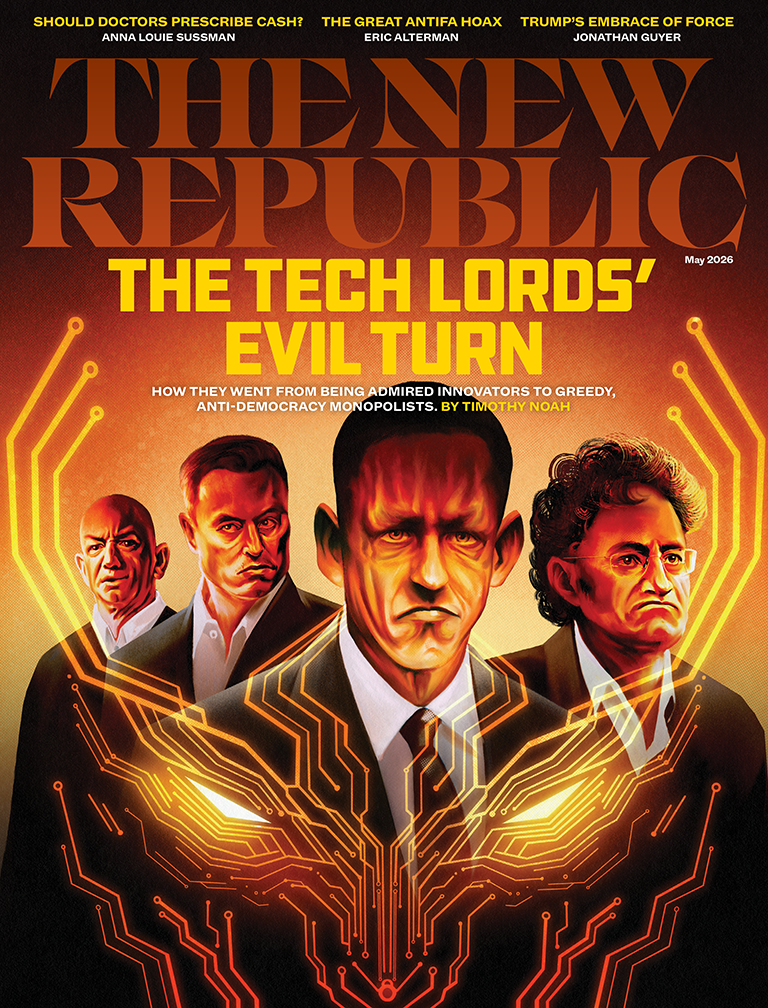
Once upon a time, they were counterculture idealists bringing power to the people. Today they’re greedy monopolists who’d sooner destroy our democracy than be reined in by government in any way—and they have to be stopped.
|
|
|
|
|
Update your personal preferences for _t.e.s.t_@example.com by clicking here.
Our mailing address is:
The New Republic, 1 Union Sq W , Fl 6 , NY , New York, NY 10003-3303, United States
Do you want to stop receiving all emails from ?
Unsubscribe from this list. If you stopped getting TNR emails, update your profile to resume receiving them.
|
|
|
|
|

.jpg)